Cathy Breslaw's Installation

Cathy Breslaw's Installation
Cathy Breslaw's Installation:Dreamscape

Tuesday, May 28, 2013

San Diego Native, Sonya Sparks, Talks About Sparks Gallery, Opening in San Diego in Behind the Scenes Interview with Cathy Breslaw


Interview with Sonya Sparks, Sparks Gallery Owner/Director, San Diego

The Sparks Gallery in the Gaslamp area of San Diego is opening its doors for the month of June for a
Sonya Sparks, Gallery Owner, and Director
preview exhibition of works of artist nominees for the San Diego Art Prize. The gallery is owned and operated by Sonya Sparks, a San Diego native with a business background and a passion for helping emerging artists and bringing quality fine art to the San Diego area.The 4500 sq ft gallery is in the mid-stages of renovation and is a work in progress – the building itself is documented on the San Diego Historic Register since 1867 when the lot originally sold for $150.00. Since then, the building has been used as a theater for a variety of performances including vaudeville in the 1920’s and other functions, a hardware store, and a rug and carpet store. Sparks is renovating the space in keeping with the ‘spirit of the original architecture’.

Sparks received her BA degree at the University of San Diego where she majored in business and and minored in art. Her family who is interested in the arts exposed her to the museums of Balboa Park and instilled an appreciation for historic buildings.  While at USD, Sparks found a particular affinity to documentary style photography.  She commented that studying photography and art was a good counterpoint to studying financial and business coursework. When she left school, Sparks went on to work in  the field of online marketing, social media and web development. While living in San Diego , Sparks identified a need to develop the art community and felt she wanted to make a contribution to its growth.
 
Historic Register Plaque
In 2011, she began investigating ideas about building a gallery in the family owned historic building at 530 Sixth Avenue. To bounce some ideas around, Sparks gives credit to former teacher and mentor, Paul Turounet, a photography professor at the University of San Diego. Together, they discussed ways in which a gallery could connect with newly graduated artists, providing a transition from school and place for exhibiting their work.  Sparks spoke of her concern about the “disconnect between art creators, collectors, and educators” and her desire to create a gallery that would reach out to local arts organizations, as well as providing a space for performances including puppet shows, poetry and short story readings and dance.

Sparks visualizes the gallery as an open space where the staff is approachable and the work is affordable for new collectors. She also wants the gallery to educate the community about art. The gallery which plans to formally open sometime in late 2013, is accepting artist submissions and hopes to exhibit a combination of painting, sculpture, mixed media, and installation. Sparks says she is looking for work that expresses a message, tells a story and elicits a response.
Interior Space of Sparks Gallery - Renovations in Progress


Sparks wants to invite everyone to the opening of  ‘New Contemporaries VI’ on Saturday June 8th, 7-10 pm. To RSVP, you can reach Sonya at:
blog.sparksgallery.com

Those wishing to follow the details of the renovation and the gallery’s transformations can do so on Sparks’ facebook page.  There is no doubt that the Sparks Gallery will make a tremendous contribution to the San Diego art scene and we look forward to the grand opening later this year.
Sparks Gallery 'name' added to front window of gallery


Friday, May 17, 2013

Art Critic and Writer, Leah Ollman Interviewed in Behind the Scenes Conversations with Cathy Breslaw


Leah Ollman suggested we meet at a Hillcrest café and as we sat on the garden patio on a sunny, warm afternoon, I could picture it as the perfect place to think and write.  Ollman began with the self-reflective comment that “writing is the way I process the world”.
Art Critic and Writer, Leah Ollman


Ollman grew up in San Diego with a father who was an architect and a mother who was a businesswoman. Having been exposed to the arts at an early age, she was a member of youth group at the Museum of Fine Art where she took a variety of studio art classes. It was at Patrick Henry High School in AP Art History where Ollman first became excited about the subject. She described her teacher Margaret Maple as fresh and dynamic and who first introduced Ollman to European art history by taking the class on a tour of the major capitals of Europe. She was able to experience “in person”, all the art history she learned in the classroom. 

Ollman went on to Scripps College in Claremont California where she majored in both Art History and Philosophy. She talked about David Rubin, a college professor and curator who ignited her interests in art by taking classes to visit Los Angeles artist studios and collectors’ homes. Ollman described these visits as an “expansive experience” giving her a greater understanding of the “ecology of the art scene”. She went on to say how important it was to see art in differing contexts and that she began to process and flush out what she had been reading and learning about in the classroom with what she saw with these “in person” visits.

Ollman described several experiences that set the stage for her art writing career. As a high school student, Ollman spent a summer in New York City where she attended Parsons School of Art where she took Communication Design classes learning about book and graphic design. During college she began writing for Images and Issues Magazine, where she learned the mechanics of how magazines function. Ollman also did an internship at the La Jolla Museum of Contemporary Art where she did research and worked in the registrar’s office.

During college, Ollman spent her senior year semester abroad at Oxford University in the UK where she studied Aesthetics, Philosophy of Art, and the History of Photography. There, Ollman met instructor Mike Weaver who had an impact on the development of her interest in photography. Weaver was a curator and writer, who had the distinction of being the first to teach American Literature at this British university. Her Oxford experience sparked more of Ollman’s interest in writing about the history of both American and British photography.

Returning from Oxford and after graduating from Scripps College, Ollman returned to San Diego where she volunteered for one year at the Museum of Photographic Arts which had recently opened its doors. There Ollman focused on membership. She created a member’s publication and member’s newsletter, as well as learning about the inner workings of an art museum. After this experience, Ollman went back to school attending the Institute of Fine Arts at New York University in New York City, where she earned an MA in Art History.  During that time, Ollman also worked at the Metropolitan Museum of Art as an intern in their Education department, where she gave public tours of the institution.

At NYU, Ollman focused her studies on her continued interest in 20th century photography. There she began a project on political photography that took place between World Wars I and II. She received the Reva and Logan Grant while in school, helping her to develop an anthologized essay later published entitled “The Worker Photography Movement: Camera as Weapon”.  Also during this time, Ollman was the Editor for the Museum of Photographic Arts’ Quarterly magazine.

Upon completion of her MA degree, Ollman began writing for Art News and became art critic and feature writer for the Los Angeles Times, local edition.  Simultaneously, she went back to work for the Museum of Photographic Arts where she received an NEA grant to help curate a show “Camera as Weapon: Worker Photography Between the Wars”.  This 1991 exhibition which included over a hundred photographs, also traveled for two years to cities including Kansas City, Boston and New York.

Leah Ollman has been writing for over 25 years, and continues to write for the LA Times. She also writes articles and exhibition reviews for Art in America, and has written for Artweek, Sculpture magazine, American Ceramics, Art Nexus, History of Photography and San Diego Magazine.

Ollman describes herself as not interested in academic writing and views her purpose as a mediator between art and the audience – making art accessible and understandable to the general public. She also sees herself as most drawn to “unannounced, unheralded art”. We talked about the San Diego art scene. Ollman views San Diego as a place with many good artists, a few museums and a small mix of galleries, but is disappointed in the diminished critical discourse and dialogue about contemporary art. Though this is in large part due to the dwindling list of newspapers and online art presence,to support art writers and critics, lack of opportunity remains a problem.

When asked about advice for artists, Ollman suggests they keep in contact with writers, introducing themselves and their work in the form of emailing images and information about their exhibitions.

Leah Ollman lives and works in San Diego with her husband Arthur Ollman and their two children.

Friday, April 12, 2013

Daniel Foster, Executive Director, Oceanside Museum of Art,Oceanside,CA, Interview: Behind the Scenes Conversations


Interview and article by Cathy Breslaw

Daniel Foster

The Oceanside Museum of Art is a regional museum of San Diego county which has seen large overall growth in the last several years in both the size and scope of its spaces, staff and exhibitions.  Six months ago Daniel Foster was hired to be the Executive Director and in our interview, Foster discussed his background and what led to his joining the Oceanside Museum. He also articulated proposed plans for its future.                                                                                             

Daniel Foster was born and raised in Woodland Hills, California.  He is the oldest of two children born to a father who is a nuclear physicist and mother who is a homemaker. While growing up, he wasn’t focused on any particular subject area but commented that he was “curious and loved learning”.  Foster spent his first two years of college at the University of California, San Diego in Revelle College which he describes as having given him a “renaissance education that combined the sciences and math with the humanities”.  Foster commented that this was where he “discovered his philosophical soul”. To complete his college education, he transferred to the University of Southern California where he majored in Business Administration.  Prior to attending USC however, he spent a year traveling through Europe, having craved an “experiential pursuit of knowledge”.

 Fighting pressures to pursue a traditional career path, Foster saw himself as a “staunch individualist”. Rather than following the corporate route in business school, he was attracted to the Entreprenurial Program at USC. He wanted to be part of creating products and ideas that were innovative and “made the world a better place”. Foster described himself as not a “hands on” creator, being more interested in academic, book knowledge. While studying business he realized that creating and running businesses are more about the sweat of the day to day technical side, and very little having to do with creativity and innovation.  He asked himself “How can I be both practical and live as an inventor and be creative?”

James Hubbell  "Group of Horses", bronze

Foster often visited museums and galleries and was in San Diego when he happened to see a Walter Wojtyla exhibition.  Having seen Wojtyla’s work was a pivotal moment in Foster’s life and having realized that Wojtyla used prismacolors, he went down to the local art store and bought prismacolor pencils.  He was determined to fill the walls of his new place in La Jolla with his own art. He was in his 20’s and he wanted to make the most of his creative moment.  He described this time as a “deep intimate journey” where he set aside the material aspirations of earning a living, to create art. He supported himself in a combination of part time jobs – selling jewelry and working in restaurants, galleries and museums, to working in the adult education program at the San Diego Art Institute. Foster commented that he is a “non-careerist” and that it is his belief that “taking care of today” is the path one should take. So he put his faith in his ‘dream’ and signed up for classes in the visual art department at UCSD.  He worked with several of the faculty there, gaining insight and feedback about his work.  He spent three to four years working on various bodies of work that included painting, photography, and poetry. When he was sure he had gone as far as he could with his work at UCSD, he decided to get an MFA at the San Francisco Art Institute.  He completed his degree in both New Genres and Painting/Sculpture and then went to work at the residency program of the Headland Center for the Arts in Sausalito where he spent two years. Interestingly enough, Foster has never exhibited or sold any of his art work.                                                       

After his many years of art-making, Foster applied for a position as Executive Director for the Riverside Museum of Art.  Admittedly, he felt he may not have had the background for some of the aspects of the job, but he felt he made up for it in his vision, philosophy and passion for the museum.  The Board of Directors agreed and he was hired. He worked as Executive Director for the Riverside Museum from 2003-2009.

Foster had very specific ideas about how he wanted to run the Riverside Museum.  He believed the number one mission was to take care of the artists in the community, and where some museums tend to marginalize artists, his was going to include them.  He believes many museums take a “country club approach” by focusing on the patrons, members and collectors - his was going to center things around artists. During his tenure at Riverside,he increased the number of exhibitions from 10-12 per year up to 25-30 shows per year, shortening the runs of each exhibition but giving the community more eclectic shows to experience. The museum also operated many educational programs for artists that ranged from setting up critique groups, to holding lectures, to workshops that centered on teaching artists about how to run a successful art career.                                                                                 

Flavia Gilmore, "Its Alright", assemblage
While at the Riverside Museum of Art, Foster was approached to become the CEO for the Riverside and San Bernadino Counties Community Foundation.  This public, non profit foundation, is one of 770 in the U.S. that focus on charitable activities to improve the quality of life for its citizens. Foster took this position as he realized that this opportunity gave him the chance to change peoples’ lives. During his time there, he accomplished his goals to improve education, environmental issues, and to establish an arts and culture plan for the communities in those counties. He helped build a San Bernadino Arts Council, raising $250 thousand dollars for this organization.  He remains as Board Chair and wants to see that this council sets up an arts and cultural organization in San Bernadino. Foster believes that building the arts and culture in an area greatly improves the overall life of the entire community.

In the spring of 2012, Foster was contacted by a board member at the Oceanside Museum of Art, letting him know there was a vacant position for Executive Director. Encouraged to apply and having also thought seriously about returning to San Diego, Foster applied and was selected to become the new Executive Director of the museum. Foster believes that strengthening the arts and culture of the Oceanside community is central to its’ becoming an economically sound city. Foster had been watching the development of the museum for several years and was impressed with the growth of its new building, membership and outstanding exhibition schedule.
 
Ellen Salk, "Emergence", oil on canvas, 6' x 8'
Foster outlined several plans for the museum.  Central to his plan, is to build what he calls an “Oceanside Cultural Consortium” – a group of both business and arts groups and to develop a collaboration among these groups.  He wants the focus of the exhibitions to be on southern California artists, and to make collectors a priority.  He intends to encourage regular exhibitions of San Diego collectors’ collections and to build an association between collectors and artists. Foster intends to greatly increase the usage of the building to include outside classes and an outside sculpture garden, to open a new gallery space on the basement level with an art instruction classroom for youth and adult art classes, and to do community outreach by expanding into satellite spaces in Del Mar, Rancho Santa Fe and Escondido.  He also wants to facilitate monthly Art Walks for the community, and to encourage the building of artists studio/lofts in Oceanside.  Long term he wants to aggressively fundraise and lead an expansion of the physical spaces of the museum in the city of Oceanside.

No doubt Daniel Foster has some ambitious plans for the Oceanside Museum of Art and we welcome his passion and enthusiasm for growing the arts and culture of San Diego county communities.
 *Note: Art images are selections from current exhibitions at the Oceanside Museum of Art

Monday, March 18, 2013

Grant Kester, UCSD, Art History Professor,Gallery Director,UCSD Gallery


Grant Kester is Professor of Art History and Director of the University Art Gallery in the Visual Arts department at the University of California, San Diego. Kester is one of the leading figures in the emerging critical dialogue around “relational” or “dialogical” art practices. With these practices Art has taken discursive elements as well as social relations as its subject and material, leaving behind the art object aesthetic. This work lives in the sphere of interhuman relationships, in which social exchange and interaction is offered.  This art practice emphasizes how art is engaged in social issues and how it makes or forms communities –and there is an important interrelationship between viewer and artist.

Kester’s journey to his current role at UCSD has taken several twists and turns and in many ways follows an organic process rather than a linear one. To begin, he was raised with his parents and sister mostly in Kansas City. His mother enjoyed crafts and engaged he and his sister in the process of making things at an early age.  Their home displayed many traditional art  reprints by Rembrandt, Renoir and others so Kester developed an awareness of fine art  His mom enrolled her children in ceramics and painting classes at the local art museum. Right from the start, Kester enjoyed the solitude of making things. While in high school, he took painting, ceramics and photography. 

Kester’s father had a tradition of documenting family events and vacations by taking lots of photos. His enthusiasm for photography rubbed off on Kester, and he followed in his fathers footsteps by studying photography at Montgomery Junior College in Bethesda, Maryland. He dropped out after one year and worked in a camera store and also for a commercial photographer. He then moved to Atlanta where he studied photography at the Art Institute for one year. While there he also worked for a table top photographer. By this time, he had gained many skills in the techniques and methods of photography. He then met a landscape photographer who introduced him to outdoor photo shooting where they would spend hours, often in silence, hiking around to locate the best spots for taking images. He also introduced Kester to large format photography and he began discovering well known photographers such as Harry Callahan, Paul Caponigro, Lee Friedlander who influenced his thinking.
"We'd Love Your Company: A Project with Ethan Breckenridge,"
curator: Michelle Hyun (February 21-May 10, 2013)

It was during this time that Kester began writing about art.  He wrote art exhibition reviews, book reviews and interviews. At this time he also began teaching the history of photography at the Southeastern Center for Photographic Arts in Atlanta. Later on, he moved back to Maryland to attend the Maryland Institute College of Art where he eventually received his BA in Art History. There he had an important mentor,  his instructor Ann Fessler, and together they curated a group exhibition of socially engaged photography for the annual conference of the Society for Photographic Education. This exhibition held in Baltimore, displayed mostly post-world war II social documentary photography featuring issues of social justice.     

 In 1987, Kester landed a job as Editor of the New Art Examiner where he ran the Washington D.C.  office.Simultaneously he also taught classes at Maryland Institute College of Art and the Corcoran school.  At this point in his career, Kester realized that he was less interested in image making and more interested in writing, teaching and scholarly pursuits. He was offered the Helena Rubenstein Fellowship to attend the Independent Study Program in Art History at the Whitney Museum of Art in NYC. Afterward, Kester was inspired by this experience and was eager to begin an advanced degree. He attended the University of Rochester where he received an MA in Art History and then went on to complete his Ph.D. in Visual and Cultural Studies. During his seven years in Rochester, Kester also worked for a media arts journal, “After Image”, where he wrote grants and edited the journal. Also during this time, Kester’s studies were highly influenced by Janet Wolff, an art historian who has written several books on the sociology of art practice, giving Kester a more broad view of  the ‘image’ as it relates to film theory, and art institutions as a social system that engages art.

Also during his studies, Kester completed a residency for 2 years at the Cranbrook Academy in Michigan heading up their Critical Studies program. Upon completion of his degree, Kester taught at Washington State University in Pullman Washington and then on to Arizona State University, where he taught classes in Contemporary Art Theory and Art History. In 2000 Kester was offered his current position at the University of California, San Diego. He teaches many courses in Art History, and Art Criticism , and seminars on both the undergrad and graduate levels.  He has also done a several year stint as Chair of the Department of Visual Arts. He stated that his primary challenge in teaching is to continue to engage students and inspire their interest in Art History – He accomplishes this by helping them to see connections that art history has with popular culture, including music, fashion and technology.
"Silent Witness: Recent Works by Ken Gonzalez-Day,"
curated by Grant Kester, Elize Mazadiego and Jenn Moreno (March 31-May 20, 2011)
                                                                                                                        
Kester’s goals at UCSD include the development of a program that is not studio based and goes along with his keen commitment to relational and dialogical art practice. He is interested in art as a conduit to environmental remediation, and issues of political, cultural and social significance. With development of this new program, Kester wishes to “transform peoples consciousness of the world” and to engage all the faculty in this process of collaboration as well. As Director of the UCSD Art Gallery, Kester has developed a curatorial program for outside curatorial scholars and students to come to the gallery to develop exhibitions that support his mission of socially and community based collaborations. Kester believes this “socially engaged” art practice is gaining momentum and he is committed to achieving his goal of creating a program at UCSD.

Kesters’ path to the present has involved a combination of  years of ‘real world’ work experience prior to and during the development of his career. He developed many skills outside the “educational system” that has both served him well and no doubt has brought richness, creativity and inspiration to his students and colleagues.
(Kester has curated numerous exhibitions and has written many articles and publications – you can view some of these at the following link: http://www.grantkester.net)
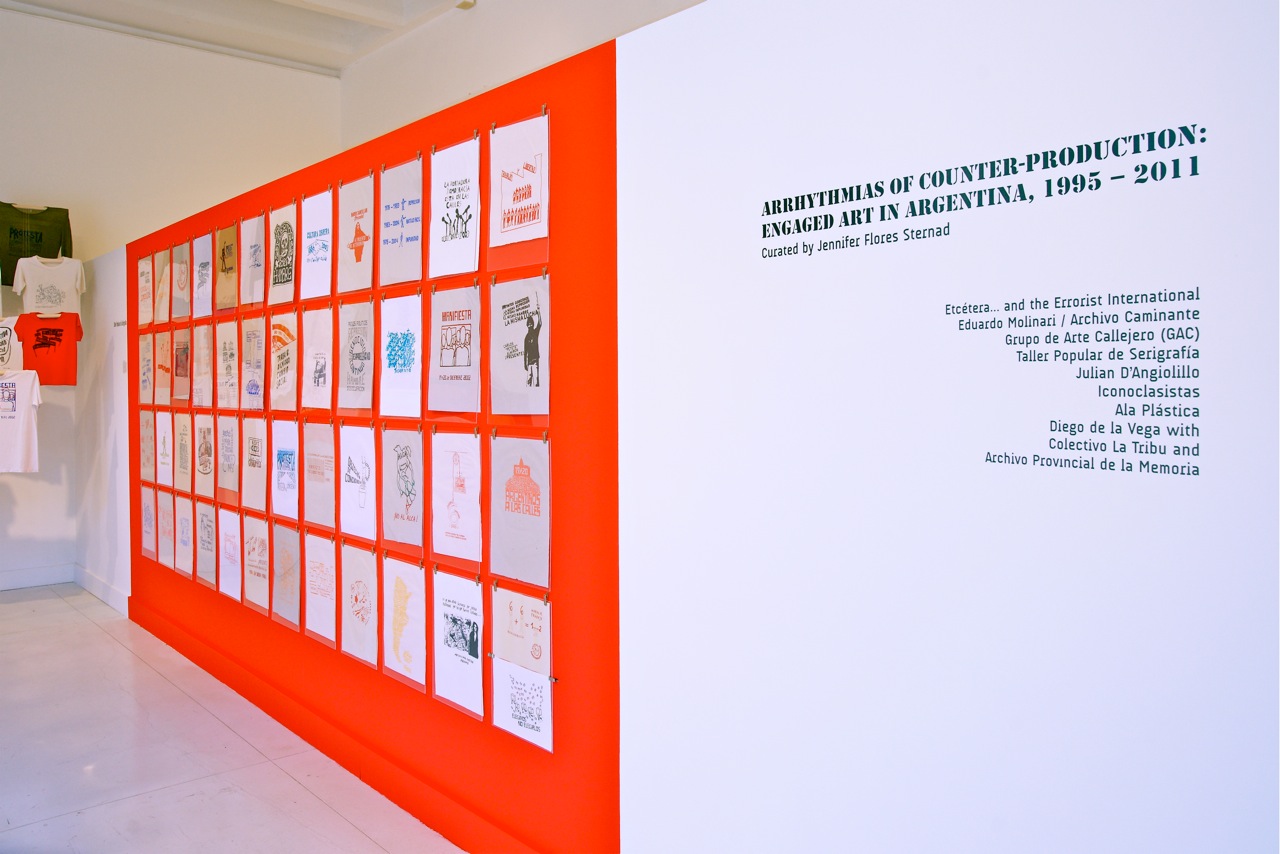
"Arrhythmias of Counter-Production: Engaged Art in Argentina,
 1995-2011,"curated by Jennifer Flores Sternad (October 6-January 20, 2012)