Cathy Breslaw's Installation

Cathy Breslaw's Installation
Cathy Breslaw's Installation:Dreamscape

Friday, August 28, 2020

Working In Isolation: How Prioritizing Family Challenged This Artist In Making Space for Art-Making

Most artists work in relative isolation.  Our collective art practices and the creative process demands it.  It goes against the human urge to congregate and socialize.  Still, we persevere as the 'call to create' nudges us.  We then deliberately make space - intellectually, emotionally and physically. We move forward quietly, with the intention and faith in the process.

Never have we been more aware of isolation than time spent in this Corona Virus pandemic environment. It is not our choice, but as artists we are familiar and in some ways ahead of the game over our fellow citizens by our familiarity and relative comfort with the loneliness of self -containment.  

Artist Ellen Deiter shares how the challenges of COVID forced her to alter her home life and art practice to accommodate the needs of her family while continuing to make space for art-making.


Pre-Pandemic:


                              Flower Power       mixed media        36" x 36"        2020


During Pandemic:


Fearless       mixed media on canvas        36" x 36"        2020


Ellen Dieter in Studio


1)     How has your work shifted during the pandemic? Has it been a change in the process of you creating art? The mediums you use? The themes or concepts you are thinking about?


When we were ordered to shelter-in-place, my practice changed drastically. With my daughter and grandsons living with me at the time, all of a sudden we were on top of each other.  I normally worked during the day while they were at school and work. Now, I was helping them during the day, get on their zooms, make food, clean, etc….So, I had to adjust my practice to work at night when the house was quiet. At first, my work continued as always, but of course the ideas of what is happening get into ones head and out onto the canvases. I did a series on feeling lost at sea, my horse and rider series took on a new look with the rider wearing masks, and some small works dealt with social distancing.  The before painting I show here with the three women expresses friendship and standing together, the shelter in place painting, with the singular person reflects on the actual times, with BLM included, which for me, I have always supported.


2) What have you discovered about yourself as an artist during this pandemic? 


I am so amazed at how adaptive the human being is. How we can continue to put one foot in front of the other in the face of adversity. When we got the orders to shelter in place, when the schools closed, I thought, there is no way we will get through this. how will we get through this. But I soon realized that every day, I got up, got dressed, made my bed and did the next designated thing that needed to be done.  I did what I needed to do to stay healthy and sane. We are not “through” this yet, so, I am continuing to do just that, one day at a time. I also realized that helping my daughter and grandsons is what kept me going.


As for as what I learned about myself as an artist, I realized, well, actually already knew, I could just stay in my studio and paint. Before Covid, I would feel guilty if I didn’t go out in the day, and just stayed in my studio. So Covid gave me permission to do just that.


 3) What have been your biggest challenges working in isolation? Surprises?


I don’t have many challenges working in isolation. Maybe the biggest surprise is how much I do enjoy working in isolation. That said, I do miss having coffee with other artists and talking in person. I miss my group yoga and dance. I belong to a womens' artist group, TWA, and I miss our in person gatherings. The lack of physical meeting is a big challenge and plays with my mental state. I am grateful for the different zoom meetings, grateful for zoom, it is an imperfect solution for now.


https://ellendieterartist.blogspot.com

https://www.facebook.com/EllenDieterArt

https://www.instagram.com/ellendieter/


Thursday, August 27, 2020

Working In Isolation: This Artist Calls Her Practice During COVID 'An Introvert's Paradise'


Most artists work in relative isolation.  Our collective art practices and the creative process demands it.  It goes against the human urge to congregate and socialize.  Still, we persevere as the 'call to create' nudges us.  We then deliberately make space - intellectually, emotionally and physically. We move forward quietly, with the intention and faith in the process.

Never have we been more aware of isolation than time spent in this Corona Virus pandemic environment. It is not our choice, but as artists we are familiar and in some ways ahead of the game over our fellow citizens by our familiarity and relative comfort with the loneliness of self -containment.  

Artist Stacy Nixon works on her art practice in remote areas of California and New Mexico, so working in isolation is comfortable for her. As Nixon puts it: 

"Working in isolation is an introvert's paradise." 


Pre-Pandemic:


                           Mollis Vox             Encaustic and Pigment on Panel               30 x 30                   2019


During Pandemic:


       Equine Standard         Encaustic Mixed Media on Paper with Gold Leaf           25 x 19               2020


1) How has your work shifted during the pandemic? Has it been a change in the process of you creating art? The mediums you use? The themes or concepts you are thinking about?

 I was fortunate enough to be wrapping up a residency program as things began to shut down in mid march. I feel like I’ve had a super extended 6 month residency, really. Pre-pandemic I was focused largely on textural detail in my work, knowing I wanted to incorporate figures but not clear on how they would come in or what their purpose was. During that residency I began to get a glimmer of what I would later develop at home during quarantine. Lots and lots of figures began showing up in the form of the animals that trot past my studio, people in interesting silhouettes against their surroundings and architectural bits and pieces. I feel like I began to unload some of the enormous swirling subconscious ideas we were all experiencing about our places in the world and in relation to each other. I also began working on large beautiful paper instead of boards as I had been. Being free to make LOTS of pieces during this time, without attachment, has been so freeing. I have nailed down a beautiful process that I am so happy with and a series I feel is truly cohesive because of the state of mind I was in when creating it. 


 2) What have you discovered about yourself as an artist during this pandemic? 

 This time has shown me how much I thrive on long periods of uninterrupted isolation. Different artists thrive on different ratios of solitude and stimulation- I think I have now figured out my ideal balance. I feel it is easier to hear what the work wants when its quiet for a long time. Also, knowing there is no hurry to complete anything or an expectation to get on with it is the best kind of freedom. It’s the introverts paradise. 


 3) What have been your biggest challenges working in isolation? Surprises? 

For me the biggest challenge has been not being able to physically connect with people around making and showing art. Getting together with people who are making art themselves or are interested in what I have made adds such a special texture to life that just doesn’t translate to the virtual world. Talking about art while standing in front of it with someone is one of life's great pleasures- it lets our humanity peek out. And just like everyone else having shows cancelled or go virtual,  has been disappointing. The thing I found most surprising is being able to let go of my dislike for technology. It is usually pretty intense. But I decided it's not all bad. I live out in the sticks in California and New Mexico, where attending a class on a whim or a guild meeting is a major undertaking- so zoom has been quite gratifying in that way. It's almost like being a fly on the wall, also an introverts paradise. 

https://stacynixonart.com

instagram: @artstac

Thursday, August 20, 2020

Working In Isolation: San Diego Artist Highlights the Importance of Social Connection to Her Art Practice


Most artists work in relative isolation.  Our collective art practices and the creative process demands it.  It goes against the human urge to congregate and socialize.  Still, we persevere as the 'call to create' nudges us.  We then deliberately make space - intellectually, emotionally and physically. We move forward quietly, with the intention and faith in the process.

Never have we been more aware of isolation than time spent in this Corona Virus pandemic environment. It is not our choice, but as artists we are familiar and in some ways ahead of the game over our fellow citizens by our familiarity and relative comfort with the loneliness of self -containment.  


San Diego artist Irene Abraham creates abstract paintings and drawings. Here, she talks about how isolation has motivated her to revisit her completed works and to "mend and revise" them as well as a push toward experimentation.  She also discusses the importance of social connection to artist friends and ties to the art community as a whole.


Pre-pandemic:


A Brighter Day        30" x 30"      mixed media       2020


During Pandemic:

Intermission         16" x 20"      mixed media          2020


Irene at Work in Studio

1) How has your work shifted during the pandemic? Has it been a change in the process of your creating art? The mediums you use? The themes or concepts you are thinking about?


I work in my home studio, so being sequestered at home has not shifted where I do my work.  While I am continuing with my main practice of painting and drawing, I have also been taking time to look through old sketch-books and re-organize my work space. 


I have also been taking old paintings and “mending” and revising them, or even totally covering them up and starting over.  It is a glorious feeling when I get to the point where I think I have finally resolved a painting.


Since I have fewer outside events now, I have also been able to expand my art-making and do more experimentation with new techniques.  I have been doing a lot of sketching while on Zoom meetings and also trying out some sculpture projects using a 3-D printer.


Certainly the political situation in combination with the pandemic has had at least a subliminal affect on the art I am producing.   Maybe my unconscious use of darker hues in my painting “Intermission” reflects these concerns. 


 2) What have you discovered about yourself as an artist during this pandemic?  


Making art is still very important to me and often exhilarating even under these constrained circumstances.  Creating work is necessary to my sense of well-being. However, although I have always enjoyed working in isolation,  I find that too much isolation can be enervating.  I have had to seek out ways to contact other artists, even if it is just a phone call or Zoom meeting. I have realized how much artists depend on interaction with other artists for stimulation, feedback and encouragement. 


3) What have been your biggest challenges working in isolation?      Surprises? 


A show I was supposed to curate with a colleague has been cancelled indefinitely.  My disappointment at this not happening made me realize how much I enjoy projects like this to get artwork out in the world. With no more artist meetings, gallery openings or studio visits I’ve had to find other ways to connect to the greater art world.


Luckily, we are living in that age of the internet so posting my work on various channels allows me to get a bit of feedback and cuts down on the feeling of artistic and social isolation.  I also get to see my art friends’ work and have enjoyed visiting galleries and museums on-line.


www.ireneabraham.com


instagram:#ireneabrahamart

                     #ireneabrahamstudio


https://www.saatchiart.com/irene981


Tuesday, July 28, 2020

Working in Isolation: Oil Painter Artist Finds Freedom to Explore Mediums During Lockdown

Most artists work in relative isolation.  Our collective art practices and the creative process demands it.  It goes against the human urge to congregate and socialize.  Still, we persevere as the 'call to create' nudges us.  We then deliberately make space - intellectually, emotionally and physically. We move forward quietly, with the intention and faith in the process.
Never have we been more aware of isolation than time spent in this Corona Virus pandemic environment. It is not our choice, but as artists we are familiar and in some ways ahead of the game over our fellow citizens by our familiarity and relative comfort with the loneliness of self -containment.  


San Diego artist Melanie Taylor’s landscape oil paintings are an interpretation of observations and creation of fictions. Inspired by places experienced and known, the lockdown has given her an opportunity to experiment with the immediacy of watercolors.

Before the Pandemic:
"Before", oil on canvas, 20"x16", 2020


During the Pandemic:
"After", oil on canvas, 54"x48", 2020

1) How has your work shifted during the pandemic? Has it been a change in the process of your creating art? The mediums you use? The themes or concepts you are thinking about?

During the lockdown I was unable to go to my studio which is a 10 minute drive from my home. I usually paint with oils and can be pretty messy, so having a separate dedicated work space is a necessity. I shut the studio down in March and took watercolors, drawing equipment, papers and sketchbooks home where I set up a small table work area. Focusing on drawing and watercolor proved to be liberating and informative. I was able to complete a watercolor painting or drawing in one session, as opposed to multiple layers/days of an oil painting. I also revisited images and notes from older sketchbooks and discovered new connections. The light and transparency in the watercolors have influenced my oil paintings, a direction I might not have taken so readily had it not been for the focus within limited parameters.

2) What have you discovered about yourself as an artist during this pandemic?  

Working on a small scale made me consider mark making in the images more thoughtfully: it became a time of introspection and retrospection. The pandemic reinforced my interest in the environment and the importance of the human race reconciling with nature. I also discovered that making the effort to create, having that discipline, is very important to my state of mind! 

3) What have been your biggest challenges working in isolation?      Surprises? 

Even though painting (for me) is a solitary activity, I found being isolated from fellow artists and not being able to visit a museum or gallery challenging on a professional level. Not being able to see family and friends living abroad has also been a huge challenge, and this motivated me to draw inspiration from places and landscapes that I miss. What surprised me was the freedom I found in the work process during lockdown and in the drawings/paintings themselves. I hope that sense of freedom continues; it was a positive step aside from my usual practice and I am grateful for that.

Lockdown Home Work Table

Lockdown Sketch Books


Melanie Taylor:      https://melaniectaylor.com/

Thursday, July 23, 2020

Working In Isolation: Multidisciplinary Artist Shares Thoughts on the Human Condition Living and Working in Kolkata India


Most artists work in relative isolation.  Our collective art practices and the creative process demands it.  It goes against the human urge to congregate and socialize.  Still, we persevere as the 'call to create' nudges us.  We then deliberately make space - intellectually, emotionally and physically. We move forward quietly, with the intention and faith in the process.

Never have we been more aware of isolation than time spent in this Corona Virus pandemic environment. It is not our choice, but as artists we are familiar and in some ways ahead of the game over our fellow citizens by our familiarity and relative comfort with the loneliness of self -containment.  


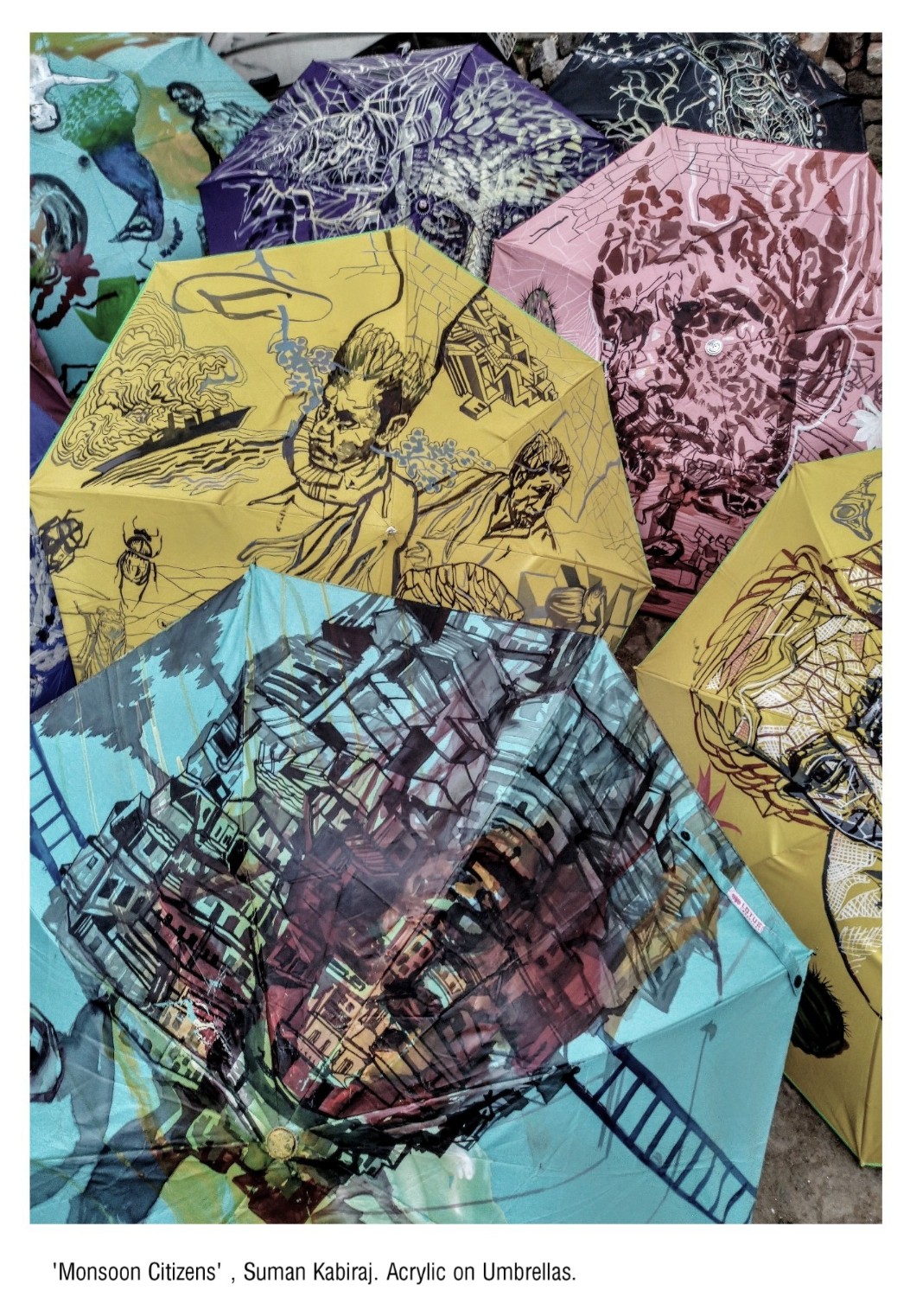
Artist Suman Kabira is from Kolkata(previously known as Calcutta) India 


He writes about his work:
The things I paint, or draw, originate from my everyday engagement with Reality. This is a Reality which, for me, is made of mundane happenings and uncanny images which penetrate into each other regularly, often unexpectedly, leaving me bewildered, yet fertile with images that keep appearing onto my works. 

Born in a semi-urban area, very close to village, I had the fortune of getting in close contact with the rural area and nature– both spatially and psycho-spatially. Then I moved to Kolkata for my art education and since then, I’ve been into the entrails of this megapolis. Such a geographical binary, and the tension within, have contributed largely to my painterly imagination. In more ways than one. 

For example, this has allowed me to perceive human bodies and nature in different settings, in different postures and hence, with different nuances. These figures recur in my works.. I keep them as they are, and at times I twist them, turn them and reduce them to the basic forms that defy the comfort of having them readily recognized as any familiar form. 

In fact, I love to revel in the dangerous beauty of nature and binaries: Dream and reality, matter and void, light and darkness. I call them dangerous because they have the ability to slip into each other’s space rendering the so-called borderline in between deeply inane and superfluous.


Before Pandemic:


During the pandemic:


1) How has your work shifted during the pandemic? Has it been a change in the process of you creating art? The mediums you use? The themes or concepts you are thinking about? 

 For my art practice, I find inspiration from my the current happenings, my surroundings, people, and society where I live. As this pandemic creates new suffering,  many new meanings for words like quarantine, lockdown, food rush, crisis, and social distancing come into my art practice which is mixed-up with my inner perspective. When it comes to the basic idea for working, it generally develops stage by stage.  New elements, subjects, perspectives and the current human condition boldly changed my general views and dimensions for rethinking and reconnecting to my new visuals, and new subjects.


2) What have you discovered about yourself as an artist during this pandemic? 

 Honestly the pandemic has given me a chance to rethink my art practice, the subject I generally choose and also for the mediums and colors I use. The pandemic also shows me the other side of a dark situation. The social distancing,  the restriction on free movement and quarantine all actually gave me feedback to connect with my inner sounds and inner imageries that have been added to my practice during this phase. Also this pandemic has offered me a different pyschological zone for discovering a new perspective. It has given me time for assessment my past works and to give ample time to think about projects on the current pandemic situation. In India during this lockdown period a few more correlated things happened. From weather causing cyclones, to different social and political issues. These incidents certainly add another perspective to my regular practice.


3) What have been your biggest challenges working in isolation? Surprises? 

 Yes there have been a few big challenges I have faced. First, it has influenced my energy when I meet common people, observing my surroundings or visiting other artists studios, gallery exhibitions etc. Also when talking to people of different classes of society, talking about their lives , journeys, struggles or success, these experiences have given me new ground to build subjects for working. No doubt this pandemic phase creates obstacles to do this. Also in isolation it has been very difficult to collect my art materials, canvases or other items I use for my work from art materials stores. I basically avoid online shopping for art materials. Also this isolation gives me the great challenge of rethinking and reconnecting to my source of subjects.

Wednesday, July 1, 2020

Working in Isolation: Los Angeles Artist Pushed to Expand Her Boundaries


Most artists work in relative isolation.  Our collective art practices and the creative process demands it.  It goes against the human urge to congregate and socialize.  Still, we persevere as the 'call to create' nudges us.  We then deliberately make space - intellectually, emotionally and physically. We move forward quietly, with the intention and faith in the process.
Never have we been more aware of isolation than time spent in this Corona Virus pandemic environment. It is not our choice, but as artists we are familiar and in some ways ahead of the game over our fellow citizens by our familiarity and relative comfort with the loneliness of self -containment.  

Los Angeles artist Jennifer Miller shares her thoughts about making art during the pandemic.

Before the pandemic:


“When You Look At Art, The Art Looks Back At You”
16 x 20
Acrylic, wood, paint skins on canvas

During the pandemic:


“A Great Retirement Plan”
12 x 12
Acrylic, mesh and cheesecloth on canvas
“Dancer #2”
Acrylic and mesh and cheesecloth on canvas
16" x 12"

“Social Distancing. Some Are Better At It Than Others”
Acrylic and found material on canvas. 20 x 24


1) How has your work shifted during the pandemic? 
Has it been a change in the process of you creating art? The mediums 
you use? The themes or concepts you are thinking about?

I have become incredibly productive. Being stuck at home I find myself painting all day, every day. It is a rare day that goes by that I’m not working in my tiny studio upstairs in my house. Without access to going out for inspiration or new paints or mediums, I started working with what I had at home. I came up with a technique that I have not seen anyone else in the world do. Maybe I’m just not able to find other examples of this type of work but I’ve looked hard and haven’t seen anything like it. I think I was just forced into being more creative by the lack of any creativity available outside the house. In addition to this new technique I also found myself doing abstracts which I’ve never done in my life. I have no idea where that came from. Maybe the forced isolation just pushed me to expand my boundaries.  

2) What have you discovered about yourself as an artist during this pandemic
 I’ve discovered that I have so many ideas that I don’t know what to do with them. I will start five paintings at a time and they will be in various stages of completion. I write down ideas of paintings I want to do but then I end up starting something that’s not even on my list. So I’ve learned that even if I have a dry spell, which sometimes can happen, that the creative ideas are always somewhere inside me. I’ve also learned even more than previously that I don’t like to waste anything. I have frequently worked previously with paint skins but now I’m finding bits and pieces around the studio and I’m using those as well. 


3) What have been your biggest challenges working in isolation?      Surprises? 

My biggest challenge is not being able to get my work in front of people. Because what I do is very three-dimensional and textural it doesn’t photograph as well as if you were to see it in person. There are no art shows to go to, I can’t visit galleries and talk to gallery owners, things like that. Also I have run out of canvases and I’ve had to use old paintings that I no longer like and I paint over them. I know I could order online but when I buy canvases I kind of like to go to the store and look at them in person and visualize what I want to do with them. It’s hard for me to buy them online. 


Monday, June 29, 2020

Working in Isolation: One London Artist Uses Time to Experiment with Installation


Most artists work in relative isolation.  Our collective art practices and the creative process demands it.  It goes against the human urge to congregate and socialize.  Still, we persevere as the 'call to create' nudges us.  We then deliberately make space - intellectually, emotionally and physically. We move forward quietly, with the intention and faith in the process.
Never have we been more aware of isolation than time spent in this Corona Virus pandemic environment. It is not our choice, but as artists we are familiar and in some ways ahead of the game over our fellow citizens by our familiarity and relative comfort with the loneliness of self -containment.  

London artist Neha Chandaria uses time in isolation to experiment with digital installations.

Before the pandemic:

Untitled       gouache on paper       7" x 5.5"       2019
During the Pandemic: 

Cabinet Views 3   Digital Installation        mixed media   19" x 27"    2020

Cabinet Views 2    Digital Installation    mixed media    17" x 17"     2020


 Untitled     pencil and collage,writing paper 11"x 7.5"  2020

      Untitled   pencil and collage on fragments of writing paper   7.5" x 5"   2020


1) How has your work shifted during the pandemic? 
Has it been a change in the process of you creating art? The mediums 
you use? The themes or concepts you are thinking about?

My artworks over the years has had a very slow and gradual change. I have a low appetite to explore or add new motifs into my works. I like to explore/repeat motifs or similar motifs in my works and time during this Pandemic is no different. During the Pandemic I've been interested in exploring cabinet spaces- to display or make artworks in relation to these furniture spaces; somehow all this is influenced by confinement inside my home for months now. 

I've made a few works titled Cabinet Views, where I used photographs and a digital medium to create a dialogue with the inside of the cabinets and the objects in it. Sharing images of the same, hoping to take these formative experiments to the next level. 

In terms of the medium, I am also thinking of exploring felting medium.

2) What have you discovered about yourself as an artist during this pandemic
I really liked the home-studio concept. During the pandemic I saw new possibilities of creating a dialogue with one’s immediate surrounding especially at home. During this time, more than creating artworks or final products, I enjoy reading about art, looking at art, contemplating art, writing about artworks, etc.
3) What have been your biggest challenges working in isolation? Surprises?
During the Pandemic I began working on lined writing paper, with motifs rendered as text in a pencil medium. 
I can’t think of any challenges as such, but I miss my community art practice and the art room in London where I teach art to children. 
The major challenge was that due to the pandemic, a group show including my work in London was shelved and postponed.