Cathy Breslaw's Installation

Cathy Breslaw's Installation:Dreamscape
Tuesday, May 28, 2013
Artful Life By Cathy: San Diego Native, Sonya Sparks, Talks About Sparks...
Artful Life By Cathy: San Diego Native, Sonya Sparks, Talks About Sparks...: Interview with Sonya Sparks, Sparks Gallery Owner/Director, San Diego The Sparks Gallery in the Gaslamp area of San Diego is...

San Diego Native, Sonya Sparks, Talks About Sparks Gallery, Opening in San Diego in Behind the Scenes Interview with Cathy Breslaw
Interview with Sonya
Sparks, Sparks Gallery Owner/Director, San Diego
The Sparks Gallery in the Gaslamp area of San Diego is
opening its doors for the month of June for a
 |
| Sonya Sparks, Gallery Owner, and Director |
preview exhibition of works of artist nominees for the San
Diego Art Prize. The gallery is owned and operated by Sonya Sparks, a San Diego
native with a business background and a passion for helping emerging artists
and bringing quality fine art to the San Diego area.The 4500 sq ft gallery is in the mid-stages of renovation
and is a work in progress – the building itself is documented on the San Diego
Historic Register since 1867 when the lot originally sold for $150.00. Since
then, the building has been used as a theater for a variety of performances
including vaudeville in the 1920’s and other functions, a hardware store, and a
rug and carpet store. Sparks is renovating the space in keeping with the ‘spirit
of the original architecture’.
Sparks received her BA degree at the University of San Diego
where she majored in business and and minored in art. Her family who is interested in the arts
exposed her to the museums of Balboa Park and instilled an appreciation for
historic buildings. While at USD, Sparks
found a particular affinity to documentary style photography. She commented that studying photography and
art was a good counterpoint to studying financial and business coursework. When
she left school, Sparks went on to work in the field of online marketing, social media
and web development. While living in San Diego , Sparks identified a need to
develop the art community and felt she wanted to make a contribution to its
growth.
 |
| Historic Register Plaque |
In 2011, she began investigating ideas about building a
gallery in the family owned historic building at 530 Sixth Avenue. To bounce some ideas around, Sparks
gives credit to former teacher and mentor, Paul Turounet, a photography
professor at the University of San Diego. Together, they discussed ways in
which a gallery could connect with newly graduated artists, providing a transition
from school and place for exhibiting their work. Sparks spoke of her concern about the
“disconnect between art creators, collectors, and educators” and her desire to
create a gallery that would reach out to local arts organizations, as well as
providing a space for performances including puppet shows, poetry and short
story readings and dance.
Sparks visualizes the gallery as an open space where the
staff is approachable and the work is affordable for new collectors. She also wants the gallery to
educate the community about art. The gallery which plans to formally open sometime in late
2013, is accepting artist submissions and hopes to exhibit a combination of painting, sculpture, mixed
media, and installation. Sparks says she is looking for work that expresses a
message, tells a story and elicits a response.
 |
| Interior Space of Sparks Gallery - Renovations in Progress |
Sparks wants to invite everyone to the opening of ‘New Contemporaries VI’ on Saturday June 8th, 7-10 pm. To RSVP, you can reach Sonya at:
blog.sparksgallery.com
Those wishing to follow the details of the renovation and the
gallery’s transformations can do so on Sparks’ facebook page.
There is no doubt that the Sparks Gallery will make a tremendous contribution
to the San Diego art scene and we look forward to the grand opening later this
year.
 |
| Sparks Gallery 'name' added to front window of gallery |
Friday, May 17, 2013
Art Critic and Writer, Leah Ollman Interviewed in Behind the Scenes Conversations with Cathy Breslaw
Leah Ollman suggested we meet at a Hillcrest café and as we
sat on the garden patio on a sunny, warm afternoon, I could picture it as the
perfect place to think and write. Ollman
began with the self-reflective comment that “writing is the way I process the
world”.
 |
| Art Critic and Writer, Leah Ollman |
Ollman grew up in San Diego with a father who was an architect
and a mother who was a businesswoman. Having been exposed to the arts at an
early age, she was a member of youth group at the Museum of Fine Art where she
took a variety of studio art classes. It was at Patrick Henry High School in AP
Art History where Ollman first became excited about the subject. She described
her teacher Margaret Maple as fresh and dynamic and who first introduced Ollman
to European art history by taking the class on a tour of the major capitals of
Europe. She was able to experience “in person”, all the art history she learned
in the classroom.
Ollman went on to Scripps College in Claremont California
where she majored in both Art History and Philosophy. She talked about David
Rubin, a college professor and curator who ignited her interests in art by
taking classes to visit Los Angeles artist studios and collectors’ homes.
Ollman described these visits as an “expansive experience” giving her a greater
understanding of the “ecology of the art scene”. She went on to say how
important it was to see art in differing contexts and that she began to process
and flush out what she had been reading and learning about in the classroom
with what she saw with these “in person” visits.
Ollman described several experiences that set the stage for
her art writing career. As a high school student, Ollman spent a summer in New
York City where she attended Parsons School of Art where she took Communication
Design classes learning about book and graphic design. During college she began
writing for Images and Issues Magazine, where she learned the mechanics of how magazines
function. Ollman also did an internship at the La Jolla Museum of Contemporary
Art where she did research and worked in the registrar’s office.
During college, Ollman spent her senior year semester abroad
at Oxford University in the UK where she studied Aesthetics, Philosophy of Art,
and the History of Photography. There, Ollman met instructor Mike Weaver who
had an impact on the development of her interest in photography. Weaver was a
curator and writer, who had the distinction of being the first to teach American
Literature at this British university. Her Oxford experience sparked more of
Ollman’s interest in writing about the history of both American and British
photography.
Returning from Oxford and after graduating from Scripps
College, Ollman returned to San Diego where she volunteered for one year at the
Museum of Photographic Arts which had recently opened its doors. There Ollman
focused on membership. She created a member’s publication and member’s
newsletter, as well as learning about the inner workings of an art museum.
After this experience, Ollman went back to school attending the Institute of
Fine Arts at New York University in New York City, where she earned an MA in
Art History. During that time, Ollman
also worked at the Metropolitan Museum of Art as an intern in their Education
department, where she gave public tours of the institution.
At NYU, Ollman focused her studies on her continued interest
in 20th century photography. There she began a project on political
photography that took place between World Wars I and II. She received the Reva
and Logan Grant while in school, helping her to develop an anthologized essay later
published entitled “The Worker Photography Movement: Camera as Weapon”. Also during this time, Ollman was the Editor
for the Museum of Photographic Arts’ Quarterly magazine.
Upon completion of her MA degree, Ollman began writing for
Art News and became art critic and feature writer for the Los Angeles Times,
local edition. Simultaneously, she went
back to work for the Museum of Photographic Arts where she received an NEA
grant to help curate a show “Camera as Weapon: Worker Photography Between the
Wars”. This 1991 exhibition which
included over a hundred photographs, also traveled for two years to cities
including Kansas City, Boston and New York.
Leah Ollman has been writing for over 25 years, and continues
to write for the LA Times. She also writes articles and exhibition reviews for
Art in America, and has written for Artweek, Sculpture magazine, American
Ceramics, Art Nexus, History of Photography and San Diego Magazine.
Ollman describes herself as not interested in academic
writing and views her purpose as a mediator between art and the audience –
making art accessible and understandable to the general public. She also sees
herself as most drawn to “unannounced, unheralded art”. We talked about the San
Diego art scene. Ollman views San Diego as a place with many good artists, a
few museums and a small mix of galleries, but is disappointed in the diminished
critical discourse and dialogue about contemporary art. Though this is in large
part due to the dwindling list of newspapers and online art presence,to support
art writers and critics, lack of opportunity remains a problem.
When asked about advice for artists, Ollman suggests they
keep in contact with writers, introducing themselves and their work in the form
of emailing images and information about their exhibitions.
Leah Ollman lives and works in San Diego with her husband
Arthur Ollman and their two children.
Friday, April 12, 2013
Daniel Foster, Executive Director, Oceanside Museum of Art,Oceanside,CA, Interview: Behind the Scenes Conversations
Interview and article by
Cathy Breslaw
 |
Daniel Foster |
The Oceanside Museum of Art is
a regional museum of San Diego county which has seen large overall growth in
the last several years in both the size and scope of its spaces, staff and
exhibitions. Six months ago Daniel
Foster was hired to be the Executive Director and in our interview, Foster
discussed his background and what led to his joining the Oceanside Museum. He
also articulated proposed plans for its future.
Daniel Foster was born and
raised in Woodland Hills, California. He
is the oldest of two children born to a father who is a nuclear physicist and
mother who is a homemaker. While growing up, he wasn’t focused on any
particular subject area but commented that he was “curious and loved learning”. Foster spent his first two years of college
at the University of California, San Diego in Revelle College which he
describes as having given him a “renaissance education
that combined the sciences and math with the humanities”. Foster commented that this was where he
“discovered his philosophical soul”. To complete his college education, he
transferred to the University of Southern California where he majored in
Business Administration. Prior to
attending USC however, he spent a year traveling
through Europe, having craved an “experiential pursuit of knowledge”.
Fighting pressures to pursue a
traditional career path, Foster saw himself as a “staunch individualist”.
Rather than following the corporate route in business school, he was attracted
to the Entreprenurial Program at USC. He wanted to be part of
creating products and ideas that were innovative and “made the world a better
place”. Foster described himself as
not a “hands on” creator, being more interested in academic, book knowledge.
While studying business he realized that creating and running businesses are
more about the sweat of the day to day technical side, and very little having
to do with creativity and innovation. He
asked himself “How can I be both practical and live as an inventor and be
creative?”
 |
| James Hubbell "Group of Horses", bronze |
Foster often visited museums
and galleries and was in San Diego when he happened to see a Walter Wojtyla exhibition. Having seen Wojtyla’s work was a pivotal
moment in Foster’s life and having realized that Wojtyla used prismacolors, he
went down to the local art store and bought prismacolor pencils. He was determined to fill the walls of his
new place in La Jolla with his own art. He was in his 20’s and he wanted to
make the most of his creative moment. He described this time as a “deep intimate
journey” where he set aside the material aspirations of earning a living, to
create art. He supported himself in a combination of part time jobs – selling
jewelry and working in restaurants, galleries and museums, to working in the adult
education program at the San Diego Art Institute. Foster commented that he is a
“non-careerist” and that it is his belief that “taking care of today” is the
path one should take. So he put his faith in his ‘dream’ and signed up for
classes in the visual art department at UCSD.
He worked with several of the faculty there, gaining insight and feedback
about his work. He spent three to four years
working on various bodies of work that included painting, photography, and
poetry. When he was sure he had gone as far as he could with his work at UCSD,
he decided to get an MFA at the San Francisco Art Institute. He completed his degree in both New Genres
and Painting/Sculpture and then went to work at the residency program of the
Headland Center for the Arts in Sausalito where he spent two years. Interestingly
enough, Foster has never exhibited or sold any of his art work.
After his many years of
art-making, Foster applied for a position as Executive Director for the
Riverside Museum of Art. Admittedly, he
felt he may not have had the background for some of the aspects of the job, but
he felt he made up for it in his vision, philosophy and passion for the
museum. The Board of Directors agreed
and he was hired. He worked as Executive Director for the Riverside Museum from
2003-2009.
Foster had very specific
ideas about how he wanted to run the Riverside Museum. He believed the number one mission was to
take care of the artists in the community, and where some museums tend to
marginalize artists, his was going to
include them. He believes many museums
take a “country club approach” by focusing on the patrons, members and
collectors - his was going to center things around artists. During his tenure
at Riverside,he increased the number of exhibitions from 10-12 per year up to
25-30 shows per year, shortening the runs of each exhibition but giving the community
more eclectic shows to experience. The museum also operated many educational
programs for artists that ranged from setting up critique groups, to holding lectures,
to workshops that centered on teaching artists about how to run a successful
art career.
 |
| Flavia Gilmore, "Its Alright", assemblage |
While at the Riverside Museum
of Art, Foster was approached to become the CEO for the Riverside and San
Bernadino Counties Community Foundation.
This public, non profit foundation, is one of 770 in the U.S. that focus on charitable
activities to improve the quality of life for its citizens. Foster took this
position as he realized that this opportunity gave him the chance to change
peoples’ lives. During his time there, he accomplished his goals to improve
education, environmental issues, and to establish an arts and culture plan for
the communities in those counties. He helped build a San Bernadino Arts Council,
raising $250 thousand dollars for this organization. He remains as Board Chair and wants to see
that this council sets up an arts and cultural organization in San Bernadino. Foster
believes that building the arts and culture in an area greatly improves the
overall life of the entire community.
In the spring of 2012, Foster
was contacted by a board member at the Oceanside Museum of Art, letting him
know there was a vacant position for Executive Director. Encouraged to apply
and having also thought seriously about returning to San Diego, Foster applied
and was selected to become the new Executive Director of the museum. Foster
believes that strengthening the arts and culture of the Oceanside community is
central to its’ becoming an economically sound city. Foster had been watching
the development of the museum for several years and was impressed with the
growth of its new building, membership and outstanding exhibition schedule.
 |
| Ellen Salk, "Emergence", oil on canvas, 6' x 8' |
Foster outlined several plans
for the museum. Central to his plan, is
to build what he calls an “Oceanside Cultural Consortium” – a group of both
business and arts groups and to develop a collaboration among these
groups. He wants the focus of the
exhibitions to be on southern California artists, and to make collectors a
priority. He intends to encourage
regular exhibitions of San Diego collectors’ collections and to build an
association between collectors and artists. Foster intends to greatly increase
the usage of the building to include outside classes and an outside sculpture
garden, to open a new gallery space on the basement level with an art
instruction classroom for youth and adult art classes, and to do community
outreach by expanding into satellite spaces in Del Mar, Rancho Santa Fe and
Escondido. He also wants to facilitate
monthly Art Walks for the community, and to encourage the building of artists
studio/lofts in Oceanside. Long term he
wants to aggressively fundraise and lead
an expansion of the physical spaces of the museum in the city of Oceanside.
No doubt Daniel Foster has
some ambitious plans for the Oceanside Museum of Art and we welcome his passion
and enthusiasm for growing the arts and culture of San Diego county communities.
*Note: Art images are selections from current exhibitions at the Oceanside Museum of Art
Monday, March 18, 2013
Grant Kester, UCSD, Art History Professor,Gallery Director,UCSD Gallery

Grant
Kester is Professor of Art History and Director of the University Art Gallery
in the Visual Arts department at the University of California, San Diego.
Kester is one of the leading figures in the emerging critical dialogue around
“relational” or “dialogical” art practices. With these practices Art has taken discursive elements
as well as social relations as its subject and material, leaving behind the art object aesthetic.
This work lives in the sphere of
interhuman relationships, in which social exchange and interaction is
offered. This art practice emphasizes how art is engaged in social issues
and how it makes or forms communities –and there is an important interrelationship
between viewer and artist.
Kester’s
journey to his current role at UCSD has taken several twists and turns and in
many ways follows an organic process rather than a linear one. To begin, he
was raised with his parents and sister mostly in Kansas City. His
mother enjoyed crafts and engaged he and his sister in the process of making
things at an early age. Their home
displayed many traditional art reprints by
Rembrandt, Renoir and others so Kester developed an awareness of fine art His mom enrolled her children in ceramics
and painting classes at the local art museum. Right from the start, Kester
enjoyed the solitude of making things. While in high school, he took painting,
ceramics and photography.
Kester’s
father had a tradition of documenting family events and vacations by taking
lots of photos. His enthusiasm for photography rubbed off on Kester, and he
followed in his fathers footsteps by studying photography at Montgomery Junior
College in Bethesda, Maryland. He dropped out after one year and worked in a
camera store and also for a commercial photographer. He then moved to Atlanta
where he studied photography at the Art Institute for one year. While there he
also worked for a table top photographer. By this time, he had gained many
skills in the techniques and methods of photography. He then met a landscape
photographer who introduced him to outdoor photo shooting where they would
spend hours, often in silence, hiking around to locate the best spots for
taking images. He also introduced Kester to large format photography and he
began discovering well known photographers such as Harry Callahan, Paul Caponigro,
Lee Friedlander who influenced his thinking.
 |
| "We'd Love Your Company: A Project with Ethan Breckenridge," curator: Michelle Hyun (February 21-May 10, 2013) |
It
was during this time that Kester began writing about art. He wrote art exhibition reviews, book
reviews and interviews. At this time he also began teaching the history of
photography at the Southeastern Center for Photographic Arts in Atlanta. Later
on, he moved back to Maryland to attend the Maryland Institute College of Art where he eventually received his BA in Art History. There he had an important mentor, his
instructor Ann Fessler, and together they curated a group exhibition of
socially engaged photography for the annual conference of the Society for
Photographic Education. This exhibition held in Baltimore, displayed mostly
post-world war II social documentary photography featuring issues of social justice.
In
1987, Kester landed a job as Editor of the New Art Examiner where he ran the Washington D.C. office.Simultaneously he also taught
classes at Maryland Institute College of Art and the Corcoran school. At this point in his career, Kester realized
that he was less interested in image making and more interested in writing,
teaching and scholarly pursuits. He
was offered the Helena Rubenstein Fellowship to attend the Independent Study
Program in Art History at the Whitney Museum of Art in NYC. Afterward, Kester
was inspired by this experience and was eager to begin an advanced degree. He
attended the University of Rochester where he received an MA in Art History and
then went on to complete his Ph.D. in Visual and Cultural Studies. During his
seven years in Rochester, Kester also worked for a media
arts journal, “After Image”, where he wrote grants and edited the journal. Also
during this time, Kester’s studies were highly influenced by Janet Wolff, an
art historian who has written several books on the sociology of art practice,
giving Kester a more broad view of the
‘image’ as it relates to film theory, and art institutions as a social system
that engages art.
Also
during his studies, Kester completed a residency for 2 years at the Cranbrook Academy
in Michigan heading up their Critical Studies program. Upon completion of his
degree, Kester taught at Washington State University in Pullman Washington and
then on to Arizona State University, where he taught classes in Contemporary
Art Theory and Art History. In 2000 Kester was offered his current position at the
University of California, San Diego. He
teaches many courses in Art History, and Art Criticism , and seminars on both
the undergrad and graduate levels. He
has also done a several year stint as Chair of the Department of Visual Arts.
He stated that his primary challenge in teaching is to continue to engage
students and inspire their interest in Art History – He accomplishes this by helping
them to see connections that art history has with popular culture, including music, fashion and
technology.
 |
| "Silent Witness: Recent Works by Ken Gonzalez-Day," curated by Grant Kester, Elize Mazadiego and Jenn Moreno (March 31-May 20, 2011) |
Kester’s
goals at UCSD include the development of a program that is not studio based and
goes along with his keen commitment to relational and dialogical art practice.
He is interested in art as a conduit to environmental remediation, and issues
of political, cultural and social significance. With development of this
new program, Kester
wishes to “transform peoples consciousness of the world” and to engage all the
faculty in this process of collaboration as well. As Director of the UCSD Art Gallery,
Kester has developed a curatorial program for outside curatorial scholars and
students to come to the gallery to develop exhibitions that support his mission
of socially and community based collaborations. Kester believes this “socially
engaged” art practice is gaining momentum and he is committed to achieving his
goal of creating a program at UCSD.
Kesters’
path to the present has involved a combination of years of ‘real world’ work experience prior
to and during the development of his career. He developed many skills outside
the “educational system” that has both served him well and no doubt has brought
richness, creativity and inspiration to his students and colleagues.
(Kester has curated
numerous exhibitions and has written many articles and publications – you can
view some of these at the following link: http://www.grantkester.net)
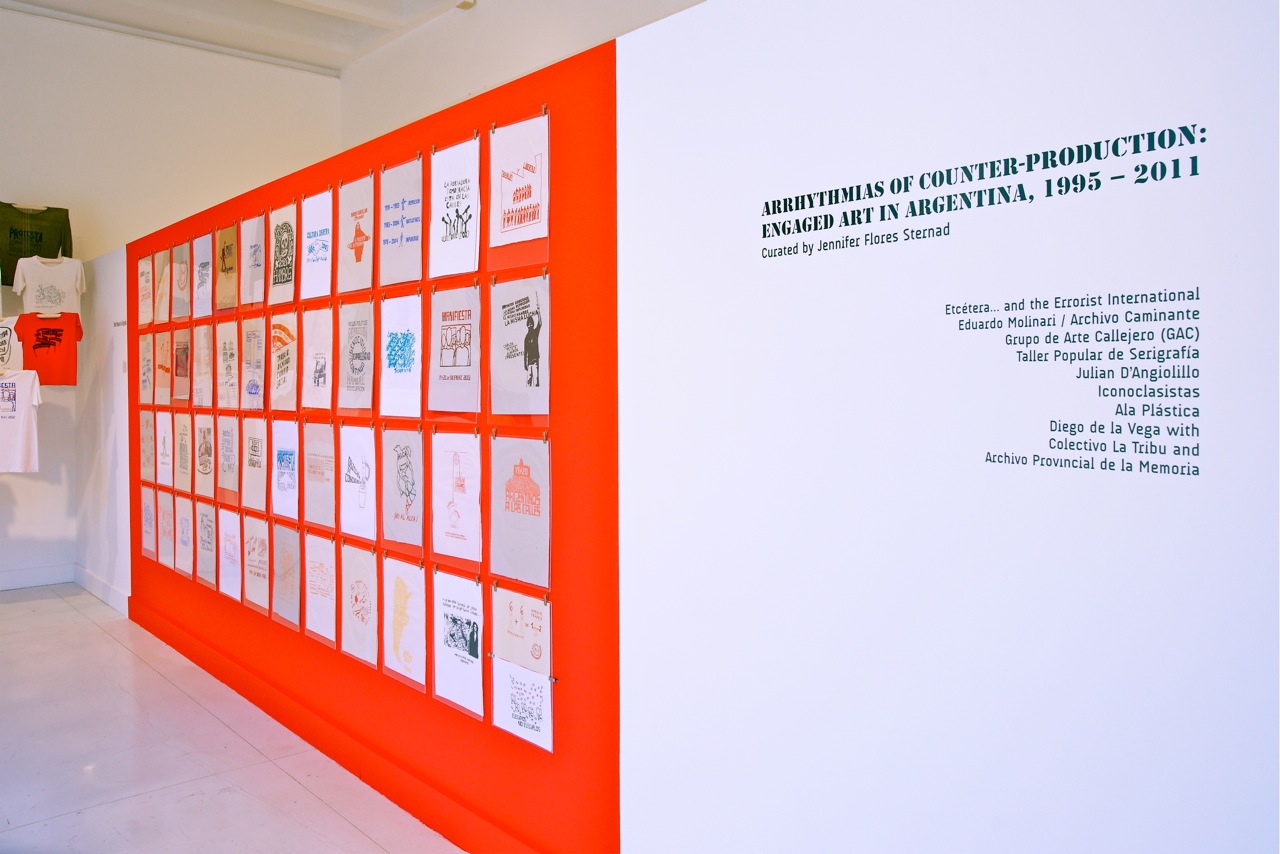 |
| "Arrhythmias of Counter-Production: Engaged Art in Argentina, 1995-2011,"curated by Jennifer Flores Sternad (October 6-January 20, 2012) |
Subscribe to:
Posts (Atom)