Cathy Breslaw's Installation

Cathy Breslaw's Installation
Cathy Breslaw's Installation:Dreamscape

Friday, March 11, 2016

Inaugural Exhibition "Revolution in the Making" Hauser, Wirth & Schimmel, Los Angeles

Revolution in the Making, Inaugural Exhibition at Hauser, Wirth & Schimmel, Los Angeles

Curators:  Paul Schimmel and Jenni Sorkin

March 13 – September 4, 2016


Article by Cathy Breslaw
www.cathybreslaw.com
vanguardculture.com

Magdalena Abaknowicz   Wheel with Rope, Wood, burlap, hemp, metal line2 wheels, each: 7ft 8 1/8 in / 2.34 m
                       2 ropes, each approx. 190 ft / 58       National Museum in Wroclaw (Poland)          1973

Out of a 100,000 square foot, 100 year old former flour mill, Hauser, Wirth & Schimmel have carved out an architectural space created for viewing and experiencing art, housed in the recently developing Arts District of Los Angeles. As Schimmel addressed the press at the gallery’s preview opening: “It is a space meant to expand the notion of what a gallery can be – nurturing a cultural community, a seamless urban experience that doesn’t separate art from life. “ With the inaugural exhibition, “Revolution in the Making”,  curators Paul Schimmel and Jenni Sorkin mimic the revisionism of this commercial manufacturing space with the revisionistic qualities in the work of women sculptors spanning the past seventy years.  The gallery invites art viewing throughout the humongous breezeways, spacious gallery spaces, bookstore, planned public gardens, soon-to-be restaurant and educational programs - all designed to urge visitors to slow down, view art more experientially and to re-visit these spaces not as a destination, but as part of day-to-day life. Artists Ruth Asawa, Lee Bontecou, Louise Bourgeous, and Louise Nevelson are the authentic revolutionaries in sculpture, as they emerged  during the post-war period when male abstract expressionist painters and sculptors dominated the art world. The women sculptors that followed and into today, stand on the shoulders of these women who transformed the language, materials and artistic approaches to abstract sculpture, bringing a female sensibility, and a success and acceptance that hadn’t previously existed.  Also represented in the exhibition are the women artists who followed during the decades of the 60’s and 70’s including Eva Hesse, Lynda Benglis, Sheila Hicks, Magdalena Abakanowicz, and Gego who were noted as post-minimalist artists who used process oriented materials and methods using wire, latex, rope, organic and natural materials like saplings and earth, and ephemeral materials like wax and paper. Through stacking, layering, pouring, cutting, draping, gouging, weaving and intertwining, these artists investigate multi-dimensional space, non-archival materials, and intuitive processes of art-making that created both physical and psychologically challenging works. Artists representing works originally created in the decades of the 80’s and 90’s, saw a transitional shift from more object based works, to an expanded use of space into making  installation-based works.  Liz Larner, Marisa Merz, Isa Genzken, Cristina Inglesias are part of this Post-Modernist era exhibited in this show.  The newer generations of artists who were commissioned to produce works for this show include: Phyllida Barlow, Karla Black, Jessica Stockholder, Abigail DeVille, Sonia Gomes, Rachel Khedoori, Lara Schnitger, Shinique Smith, and Kaari Upson. These works create immersive, richly hued environments that embrace domestic materials, craft, recycled and repurposed materials.  These are mostly 3-D installations that invite viewers to become part of the art piece as felt while walking through Abigail Deville’s structural mazes created from reclaimed plywood theater flats, lumber and debris. This exhibition of 100 works by 34 artists from across the globe invite us to witness both historical and current art-making simultaneously, educating viewers about female art-making across a broad timeline uncommonly seen in gallery exhibitions.

Lee Bontecou   Untitled      welded steel, canvas, wire, soot    1959


Liz Larner   Reticule   cast polyurethane   1999
Claire Falkenstein   Body Centered Cubic   glass fused with gold and iron wire   1960
Phyllida Barlow   Untitled:pianoframemeancover   timber,polystyrene,felt,tape,canvas,paint plywood,foam   2014

Wednesday, February 3, 2016

Ed Ruscha: Then and Now at the Museum of Contemporary Art, La Jolla, CA

Ed Ruscha:  Then and Now
Museum of Contemporary Art, La Jolla

Article by Cathy Breslaw
www.cathybreslaw.com
Ed Ruscha, Ace, 1962, oil on canvas, 71 3/8 x 66 in. Museum of Contemporary Art San Diego, Museum purchase in memory of Lois Person Osborn, 1986.28 © Ed Ruscha
On February 1st, I attended a ‘walk through’ of Ed Ruscha’s exhibition Then and Now. Given by Kathryn Kanjo, Deputy Director of the museum, attendees were led from painting to painting, as we learned about Ruscha’s work within the context of his generation and the important art movements and cultural forces that influenced Ruscha’s thoughts and ideas. The exhibition builds upon MCASD’s long-standing relationship with Ruscha – the museum holds 30 works by the artist, including the outdoor mural Brave Men of La Jolla(1995-1996). Using a combination of text and images, Ruscha produces paintings, photograghs, drawings and films that reflect the city of Los Angeles where he lives and works -  often articulating the vernacular architecture, urban landscape and car culture. Having come into his own during the 50’s and 60’s, Ruscha’s work is influenced by West Coast Pop-Art and Conceptual Art.  The works in the exhibition highlight Ruscha’s paintings from the 60’s and 2000’s, giving viewers a glimpse of both the beginnings and current phases of an over 50 year career of making art. The anchor piece of Then and Now is a large painting Ace, with a black background and the word ‘Ace’ spelled out in blue letters – there is some impasto brush work within and around the word, creating movement, depth and emotion. Often ironic and humorous, Ruscha uses text/words as well as color palette to comment on American culture.  Other works draw upon aerial perspective landscapes and diagonal compositions which add a dynamic power to these paintings. His painting The Los Angeles County Museum on Fire (1965-1968) uses aerial perspective rendering a large landscape painting of LACMA on fire, speaking to the idea of both progress and decay of cultural iconic cultural institutions. For museum goers, listening to Curator, Kanjo’s commentary and ‘back story’ of Ruscha’s life and work – pointing out Ruscha’s themes, concepts and ideas is a fun and informative way to bring an artist’s work ‘to life’.

Ed Ruscha, The Los Angeles County Museum on Fire, 1965-1968, oil on canvas, 53 1/2 x 133 1/2 in. Hirshhorn Museum and Sculpture Garden Smithsonian Institution. Gift of Joseph H. Hirshhorn, 1972 © Ed Ruscha. Photo: Cathy Carver


Monday, January 25, 2016

HB Punto Experimental Exhibits Artist Beth King's "Invisible Geometry"

Invisible Geometry   Beth King
HB Punto Experimental, San Diego
2151 Logan Ave. , Sec B
*by appointment only 760-443-9067


Locating HB Punto Experimental Gallery is an adventure in itself.  Knowing the street address is only half the journey – but the trip is worth it.  Around the corner and halfway down an alley off Evans St/Logan Avenue, you enter a gate and into a world created by gallery owner Hugo Heredia. Once inside there is a unique space Heredia has designed as a living space where art is also displayed and as Heredia explained, art can be experienced in a “ real living space’.  Alongside this large room and kitchen area, is the main exhibition space.  Long and narrow and emptying into an “L” shaped room is where the current show “Invisible Geometry” is displayed. Artist Beth King is a San Diego artist who has been working for many years to develop and hone her well crafted clear glass sculptures.  Working with a reductive simplicity of form and content, King’s sculptures remind us of the mid-twentieth century Minimalist art movement.  Her materials include clear and sandblasted glass – some flat and some bent, custom aluminum hardware, steel cable, and chrome hinges.  While her materials are narrowly defined and basic, her intent is more complex.  The mostly wall based works along one entire wall have ‘moving parts’ that can be arranged flat against the wall or in a 3-D manner as hinges move the parts back and forth. The one large floor sculpture in the main room is made of many clear curvy yet flat glass pieces that form a rectangle with aluminum connectors.  There are two cone-shaped works – one juts out perpendicular to the wall and one much larger sculpture rests on a white painted wood stand adjacent to the floor.  In her works, King gives us a view of all parts. Nothing is hidden and the hinges and hardware for the works are both artfully and functionally connected to each piece.  King’s sculptures clearly interact and at points dissolve into the ‘environment’.  Artificial and natural light play a key role in viewing the works. Wall works especially react to light with sharp shadows on the walls giving an added dimension that is unique to its location in space.  With thoroughly planned precision and attention to every detail, King offers us a vision and perception of space, light and form not routinely seen in our daily lives.


Wednesday, December 9, 2015

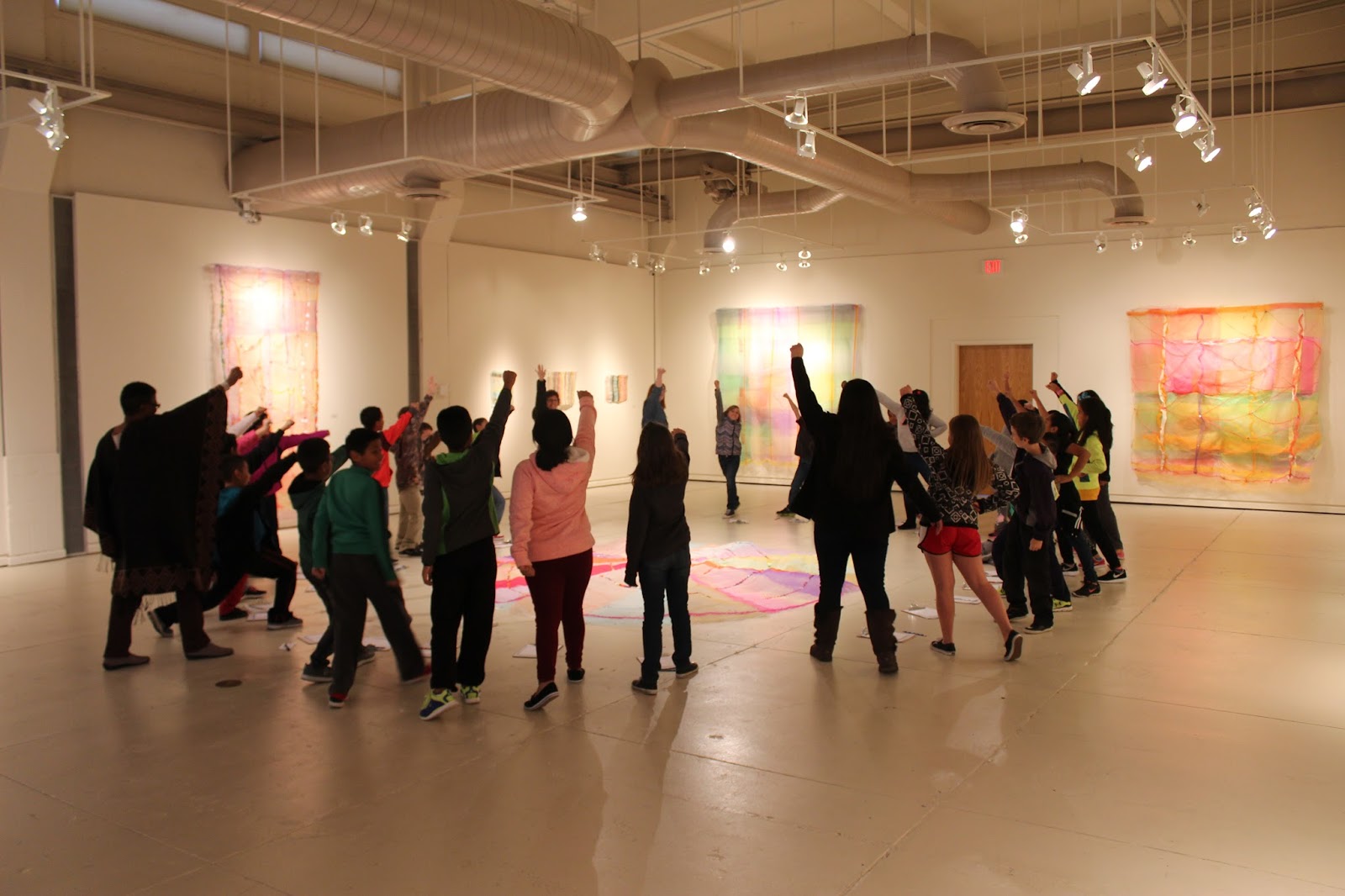
Interpretive Dance by Texas School Children at Cathy Breslaw's Exhibition: Color, Space and Beauty


Color, Space and Beauty : An Exhibition of the Work of Cathy Breslaw at the Patterson - Appleton Center for Visual Arts, Denton, Texas
Exhibition Director, Caroline Holley shared a video and photos. She explains below how the classes of school children participated in Cathy Breslaw's exhibition "Color Space Beauty" at the Patterson-Appleton Center for Visual Arts in Denton Texas....on view thru December 30th:
  See video here:

"Just a bit of insight into the tours... some of the docents have had the students walk through your show and sketch their interpretation of the individual pieces while listing descriptive words that come to their mind as they view each piece. From there, they created an interpretive dance based on the descriptive words, this is the video I included. Each docent has a different approach, for example, one docent had their group write a haiku about their favorite piece. I think it has been a great experience for everyone involved!
Finally, you’ll see some photos of the interactive work stations we created for the kids this year where they have a chance to create their own fiber creations which were inspired by your “Carousel” piece. Each class creates a base and the next group adds layers to it. A local furniture store donated thousands of left over swatches for us to use – the kids have loved it!" (Caroline Holley, Exhibition Director)


Wednesday, December 2, 2015

The Art of Music, a Multi-Media Exhibition at The San Diego Museum of Art

The Art of Music
San Diego Museum of Art, San Diego

Article by Cathy Breslaw

John Baldassari       "Beethoven's Trumpet(with Ear) Opus #127 "      2007  


Upon entering the exhibition The Art of Music  viewers are met with a huge wall sculpture by contemporary artist John Baldessari.  It consists of an enormous white-painted human ear with a large trumpet jutting out from it.  I took it as a sign that we should ‘listen carefully’, and pay as much attention to what we hear, as to what we see. At an art museum we are accustomed to focusing mostly on what we see – and The Art of Music challenges us to both listen and see simultaneously.  In the over 200 works of art presented, there are a combination of paintings, drawings, sculptures, videos, sound art, installations and musical instruments covering artists and music-makers over several hundred years of time.  This highly ambitious exhibition drawing from a variety of time periods, artists and musicians, is organized into three areas: Musician as Motif, Social Intersections of  Art and Music and Formal Connections of Art and Music. The Musician as Motif examines the motif of the musician and the symbolic nature of this figure in Greek terracotta figures, Chinese metalwork, and Western portraits of celebrated musicians. Through these we will present a visual history of the meanings associated with musicians, muses, and the individual artist at different moments and in different cultural contexts. The second section, Social Intersections of Art and Music, considers the social function of music and its public and private rituals. This spans depictions of musical performances at the court and in the theater, designs for the opera and ballet, and works portraying musical scenes of everyday life. Formal Connections of Art and Music, the third explores representations of the sounds, emotions, and sights of music, from Indian Ragamala paintings to modern and contemporary interpretations of the colors and forms evoked by music.
The works come from a combination of the museum’s permanent collection, loans from major museums and private collections. Art works from Pablo Picasso, Kandinsky, Chuck Close, Rufino Tamayo, and Henri Matisse are among the most prominent artists presented. On view is a harpsichord, lyre, violin, guitar, whistles, and Beethoven’s Fidelio from 1814, “Er Sterbel” manuscript with autograph. When viewers approach each musical instrument, there are sensors  causing music to ‘play’ a musical piece using the particular instrument viewed.  Throughout the many rooms of the exhibition, faint sounds of musical pieces can be heard adding a wonderful back-drop to the visual art pieces.  We become aware of how visual art pieces contain movement and conjure up unique sounds and that sounds from musical instruments initiate some natural visual symbols and colors.

The final art piece we experience in the last room of the exhibition is contemporary artist Tristan Perich’s “Microtonal Wall”. This wall work arranged on a 25 foot long grid, is comprised of 1500 tiny speakers, each playing its own microtonal frequency over four octaves. When a viewer gets very close to each speaker, you can hear sounds separately but when further away the sounds all seem to play at once.

The Art of Music educates, entertains and challenges us -  also reminding us of the interconnections of art and music and how each can inform the other, and stimulate our curiosity and creativity.  The show is on view through February 7th.


Arthur Dove    Fog Horns    oil on canvas     1929

Fernando Botero   Dancing in Columbia   oil on canvas    1980